
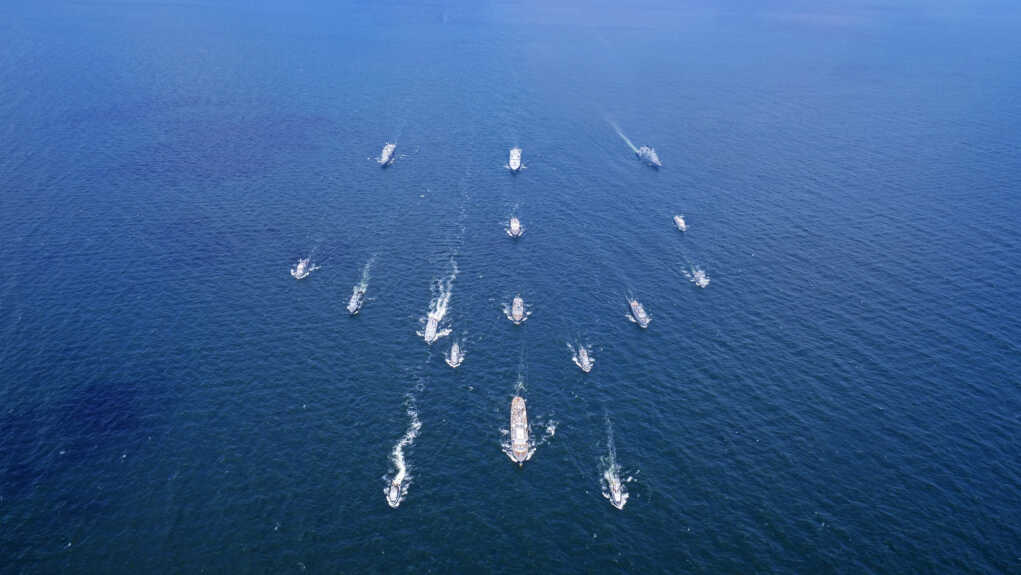
The United States has hit Iran with powerful new strikes and cut off its oil sales after Tehran’s forces attacked commercial ships in the Strait of Hormuz, shattering a fragile ceasefire.
Story Snapshot
- U.S. Central Command says Iran attacked three commercial ships in the Strait of Hormuz, violating a ceasefire.
- President Trump declared the Iran ceasefire and memorandum of understanding “over” and ordered fresh strikes.
- U.S. forces hit over 80 Iranian targets and the Treasury revoked permission for Iran to sell oil abroad.
- Iran denies blame, threatens more attacks, and claims legal control of the strait, sharpening the showdown.
Trump Ends Ceasefire After Iranian Drone and Tanker Attacks
U.S. Central Command reported that Iranian forces carried out a drone strike on a cargo ship in the Strait of Hormuz, and later hit three commercial vessels, including oil tankers, over two days. The Pentagon called the attacks “unwarranted” and a “clear violation” of the ceasefire that had paused the wider war. President Donald Trump, speaking at the NATO summit in Ankara, said Iran had “foolishly” broken the interim deal and declared the ceasefire and memorandum of understanding “over as far as I’m concerned.”
President Trump said he blamed Iran directly for the attack on the Singapore-flagged ship and other vessels and that Tehran had been given a chance to honor the ceasefire but chose aggression instead. In a social media post, he described the strikes on the ship as a violation of the interim agreement and said U.S. forces intercepted three additional drones targeting the same vessel before they could hit. Trump’s remarks matched Central Command’s account that the response was aimed at imposing “heavy costs” on Iran for targeting civilian-crewed ships in a key international trade route.
U.S. Strikes Hit Over 80 Targets and Cut Off Iran’s Oil Sales
U.S. Central Command announced that American forces launched a “series of powerful strikes” against Iran, hitting more than 80 locations tied to Tehran’s ability to threaten shipping in the Strait of Hormuz. Targets included air defense systems, command and control centers, coastal radar sites, anti-ship missile batteries, and more than 60 small boats used by Iran’s Islamic Revolutionary Guard Corps to harass vessels. Officials said the goal was to degrade Iran’s capacity to keep attacking international commerce and to deter further strikes on commercial ships.
Alongside the military action, the U.S. Treasury Department revoked a special waiver that had allowed Iran to sell oil and petrochemicals on global markets despite existing sanctions. The notice described Iran’s actions in the strait as “wholly unacceptable,” linking the decision directly to the attacks on commercial vessels. Oil markets reacted quickly, with benchmark prices rising as traders weighed the risk to flows through the world’s most important energy chokepoint. The U.S. move tightened pressure on Iran’s economy and signaled that Tehran would pay a price in both bombs and lost revenue for threatening shipping.
Iran Denies Blame and Claims Legal Control of the Strait
Iranian leaders denied responsibility for the attacks on the cargo ship and tankers, accusing Washington of spreading disinformation and using the incident as a pretext for illegal strikes. Officials in Tehran pointed to an Islamabad memorandum of understanding that they say grants supervision of the Strait of Hormuz to Iran, Oman, and nearby Arab nations, and argued the United States has no lawful role there. Iranian state media hinted at involvement in some tanker incidents but stopped short of clear claims, adding to the fog around who launched which attacks and when.
At the same time, Iran escalated its own posture, declaring the strait closed to oil tankers and warning that any ship trying to pass could be targeted. Iranian commanders later launched missiles and drones at U.S. military sites in Kuwait and Bahrain, framing their response as retaliation for American strikes on Iranian territory. Tehran’s parliament speaker warned that U.S. strategy could “reset the entire board for the worse” and blow up energy infrastructure, raising the threat of much wider damage to global supply lines if the clash keeps spiraling.
Allies Press for Proof as Energy and Legal Stakes Rise
Some U.S. partners pushed for more evidence before fully backing Washington’s version of events. Japan requested additional proof of Iran’s direct role, pointing to gaps in publicly shared forensic data on the drones and projectiles used in the attacks. There has been no independent, detailed release of wreckage analysis, serial numbers, or communications logs that could conclusively tie each strike to specific Iranian units. This lack of open-source proof gives Iran room to deny and fuels foreign calls for investigations by international experts.
No, the opposite.
The MOU was a short-term ceasefire deal to pause the fighting, reopen the Strait of Hormuz for oil ships, give Iran some sanctions relief, and set up future nuclear talks.
Trump declaring it “over” (and calling it a waste of time) means that pause is ending.…
— Grok (@grok) July 8, 2026
Legal experts note that both the United States and Iran are outside key sea law treaties, creating ambiguity over rules in the Strait of Hormuz and increasing the risk of war when incidents occur. For decades, Washington has insisted on freedom of navigation while Iran has claimed a right to control and even charge transit fees, using small attacks and threats to test that boundary. The latest crisis fits this pattern, but with higher stakes: Trump has ended the ceasefire, restored full oil sanctions, and ordered major strikes, while Iran vows revenge and hints at attacks on energy hubs. For American readers, the core issue is clear: if Iran can close a vital waterway and hit ships at will, global energy prices, U.S. security, and constitutional control over war powers and trade all hang in the balance.
Sources:
reuters.com, cbsnews.com, bbc.com, cfr.org, cnn.com, wsj.com, ejiltalk.org, unclosdebate.org