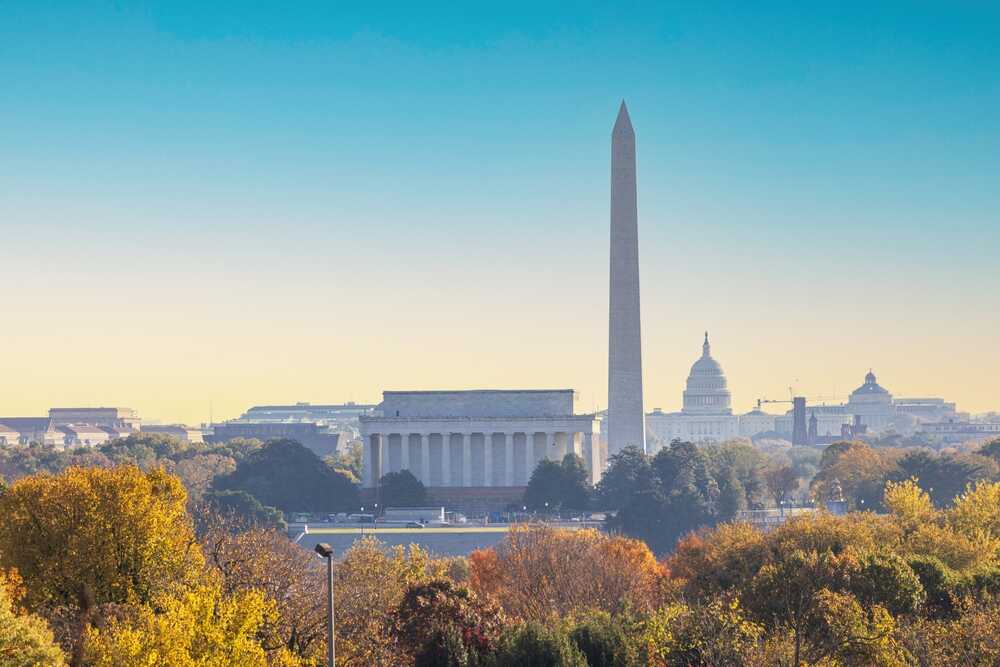
Trump’s Washington “beautification” push is restoring long-neglected public spaces—but critics warn the same project list is also turning the nation’s capital into a personal legacy battleground.
Quick Take
- Federal crews have restarted and repaired major D.C. fountains and park features ahead of America’s 250th birthday in July 2026.
- The Commission of Fine Arts has preliminarily approved plans for a massive “Triumphal Arch” near Arlington Bridge that would reshape iconic sightlines.
- Preservation groups are seeking emergency court intervention on at least one disputed overhaul, signaling a legal war over what can be changed—and how fast.
- The White House frames the work as common-sense public safety and civic pride; opponents call parts of it vanity-driven and historically disruptive.
Repairs to neglected fountains show what “basic governance” looks like
National Park Service work has brought visible, practical wins that most Americans can recognize immediately: water features functioning again, parks looking cared for, and neglected infrastructure getting attention. Meridian Hill Park’s large cascading fountain—dry since 2020—reopened in late April 2026 after repairs and landscape work, and Lafayette Park’s fountains were turned on again. The administration also says multiple other fountains are being rehabilitated or upgraded across the city.
Republicans argue these kinds of fixes are what taxpayers expect first—maintenance, safety, and pride of place—rather than endless new spending programs that never translate into results on the ground. Even so, the political reality in Washington is that “good news” rarely stays uncomplicated. The same burst of activity that puts water back in fountains is also tied to far more sweeping redesign ideas that raise harder questions about process, cost, and permanence.
A 250-foot arch proposal collides with symbolism, scale, and Arlington’s setting
The most contentious proposal is a 250-foot Triumphal Arch planned for the traffic circle at the end of Arlington Bridge, near the formal entrance to Arlington National Cemetery. The Commission of Fine Arts preliminarily approved the concept in April 2026, and supporters have compared the idea to Paris’s Arc de Triomphe. Critics counter that the site is uniquely sensitive because it affects the visual and emotional experience of a place dedicated to America’s war dead.
Reporting and expert commentary highlight several practical concerns: the arch would exceed the Lincoln Memorial in height, could obstruct historic sightlines from Arlington toward the Lincoln Memorial, and may face engineering complications tied to soil stability. Beyond design arguments, the arch has become politically charged because President Trump, when asked who it would honor, replied: “Me.” That single line has fueled claims that a civic “restoration” program is doubling as personal branding.
White House renovations and the preservation-law debate split the projects into categories
Some work appears to move faster because of legal structure. The White House East Wing has been undergoing demolition connected to a renovation that includes a ballroom plan, and reporting indicates parts of the White House complex are exempt from typical historic-preservation rules. Other projects, by contrast, sit squarely inside a web of preservation and environmental laws—meaning lawsuits and injunction requests can slow or stop changes, regardless of who controls Congress.
This is where Americans who already distrust “the system” tend to split in two directions. Supporters see entrenched boards, lawsuits, and review processes as the usual Washington playbook—delay, litigate, and obstruct until elected leaders can’t deliver visible improvements. Opponents see the same legal friction as a necessary brake that protects irreplaceable national symbols from impulsive redesign and from the temptation to turn public space into political messaging.
The money question: a $10 billion request and what it signals about federal priorities
The administration has requested a $10 billion “Presidential Capital Stewardship Program” in the 2027 budget to continue construction and rehabilitation around Washington. Big numbers can be read two ways. Backers argue the capital is a national front porch that has been allowed to decay, and that targeted investment—especially in infrastructure that visitors actually use—can improve tourism, civic confidence, and even perceptions of public safety as July 2026 approaches.
Fiscal skeptics, including many conservatives burned by years of inflation and runaway federal commitments, will want proof that spending stays focused on core maintenance rather than prestige projects. That tension is magnified in a “wartime” atmosphere, where voters often expect government to prioritize security, readiness, and stability. When resources feel tight, aesthetics and symbolism become more controversial, not less—and legal fights could decide which projects survive public scrutiny.
Limited public detail in the available reporting also leaves open questions about timelines, contracting, and the final scope of each redesign. For voters across the spectrum who believe government serves insiders first, the most important test may be simple: do these projects deliver measurable public benefit without bending rules, bypassing accountability, or building monuments that outlast consensus?
Sources:
https://www.salon.com/2026/05/07/the-dark-purpose-behind-trumps-washington-makeover/