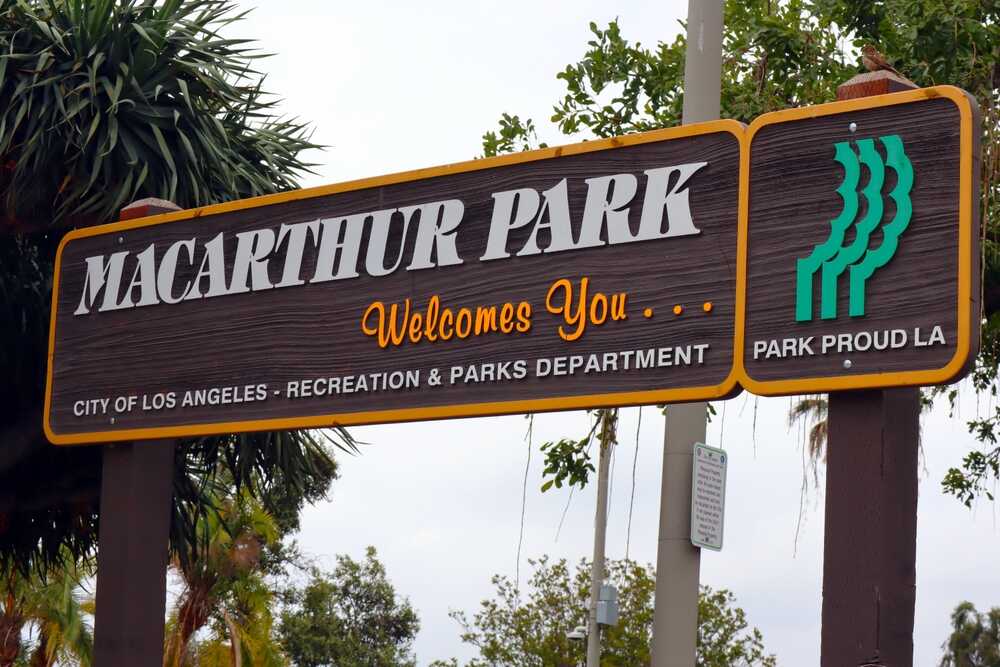
Federal agents just sent a blunt message to fentanyl dealers and the politicians who looked the other way: the “safe haven” at MacArthur Park is over.
Quick Take
- Federal and local law enforcement launched “Operation Free MacArthur Park” on May 6, 2026, targeting an open-air drug market tied to the 18th Street Gang.
- Authorities arrested 18 people, charged 25 defendants in total, and reported seven fugitives still outstanding.
- Investigators seized 19 kilograms of fentanyl—estimated at roughly $10 million in street value—along with evidence tied to drug distribution.
- Officials stressed the crackdown is intended to be sustained, not a one-day sweep that simply reshuffles dealers to nearby blocks.
A major federal crackdown hits a park that became a symbol of urban disorder
Federal agents joined the Los Angeles Police Department on May 6, 2026, to execute warrants and make arrests around MacArthur Park and nearby corridors long associated with open-air drug sales. The operation, publicly framed as “Operation Free MacArthur Park,” focused on supply networks linked to the 18th Street Gang and the fentanyl trade. Authorities said 18 people were arrested, with 25 defendants charged overall and several suspects still at large.
Investigators reported seizing 19 kilograms of fentanyl, valued by officials at about $10 million on the street, an amount that underscores how industrial the trafficking has become. Raids extended beyond the park itself, reaching locations in San Gabriel and Calabasas, reflecting a strategy that targets suppliers and stash locations rather than only street-level sellers. Officials also described serving multiple warrants on businesses along the Alvarado-area corridor.
Why MacArthur Park became ground zero for fentanyl, gangs, and public frustration
MacArthur Park’s decline has been decades in the making, shaped by gang control, waves of addiction, and the steady expansion of street homelessness. Federal affidavits and reporting describe dealers using encampments and tents as cover, making enforcement more difficult and increasing risks for families and residents who still rely on the park as one of the area’s few open spaces. The fentanyl surge after 2020 intensified overdoses and sharpened public pressure for visible order.
Repeated local sweeps in prior years often produced limited, temporary results, fueling public cynicism about a “revolving door” that punishes small-time offenses without dismantling trafficking organizations. California’s broader criminal-justice environment, including the reduced penalties for certain drug possession offenses under Proposition 47, has remained a central part of the political argument over why street dealing persists. The available reporting does not quantify how much Prop 47 alone explains MacArthur Park’s conditions, but it is frequently cited in enforcement debates.
What officials said—and what the public didn’t hear from City Hall
Federal officials used unusually direct language to frame the mission: reclaiming a public park for families and cutting off cartel-linked fentanyl pipelines that profit from misery. Statements attributed to senior Justice Department leadership and prosecutors emphasized deterrence and follow-through, signaling that agents plan to keep pressure on the area rather than declare victory after a single day. Law enforcement also highlighted that defendants could face decades in prison—or life sentences—depending on charges and prior records.
The deeper political lesson: competence matters more than slogans
The operation also spotlights a recurring fracture in modern governance: when residents see daily disorder, they judge leaders by outcomes, not programs or press releases. The research notes that Mayor Karen Bass has prioritized homelessness initiatives, yet public reporting around this operation included no prominent mayoral response or central role for City Hall. That absence is not proof of negligence by itself, but it does reinforce a perception—common across red and blue America—that local government often appears reactive while federal muscle steps in.
What comes next for Westlake—and what “success” would actually look like
Lasting success will be measured by whether trafficking returns to the park weeks and months from now, or whether the market simply relocates to adjacent blocks. Enforcement can disrupt supply and remove violent actors, but communities also watch for practical follow-through: safer sidewalks, fewer overdoses, and clear consequences for repeat offenders. Limited data is available in the provided sources on long-term overdose impacts from this specific operation, so the clearest near-term metrics are prosecutions, fugitive arrests, and sustained patrol presence.
Feds Move in on L.A.'s Drug-Infested MacArthur Park, Expose Karen Bass' Fecklessness in the Processhttps://t.co/7QpUmw5qJZ
— RedState (@RedState) May 7, 2026
For conservatives—and for many liberals exhausted by public disorder—the larger question is whether government can still perform its most basic duty: protect public spaces and uphold the rule of law without endless excuses. This case shows federal capacity when agencies coordinate, but it also highlights the political vulnerability of cities that normalize open-air drug markets. If prosecutions hold, the operation could become a template for reclaiming other high-profile hotspots nationwide, while reigniting arguments over permissive policies and accountability.
Sources:
https://www.latimes.com/california/story/2026-05-06/macarthur-park-federal-drug-market-operation
https://www.ktvu.com/news/drug-raid-los-angeles-macarthur-park