One chokepoint halfway around the world is now testing whether America will keep paying to protect global commerce while enemies and allies alike gamble with U.S. resolve.
Story Snapshot
- President Trump issued a 48-hour ultimatum demanding Iran fully reopen the Strait of Hormuz “without threat,” warning U.S. strikes on Iranian power plants if it stays closed.
- Iranian military and diplomatic officials responded by threatening retaliation against U.S. and Israeli infrastructure in the region if Iran is attacked.
- European allies and Japan publicly backed freedom of navigation and safe passage through the strait, framing it as a matter of international law.
- Iran reportedly demonstrated long-range missile capability amid the standoff, raising the stakes for U.S. forces and regional partners.
Trump’s 48-hour ultimatum raises the pressure on Tehran
President Donald Trump escalated the standoff over the Strait of Hormuz by giving Iran a 48-hour deadline to fully reopen the shipping lane. Trump said that if Iran does not open the strait “WITHOUT THREAT” within that window, the United States would strike Iranian power plants, “STARTING WITH THE BIGGEST ONE FIRST.” The ultimatum was posted publicly and ties a specific timeline to a specific set of targets, making the next steps easier to measure.
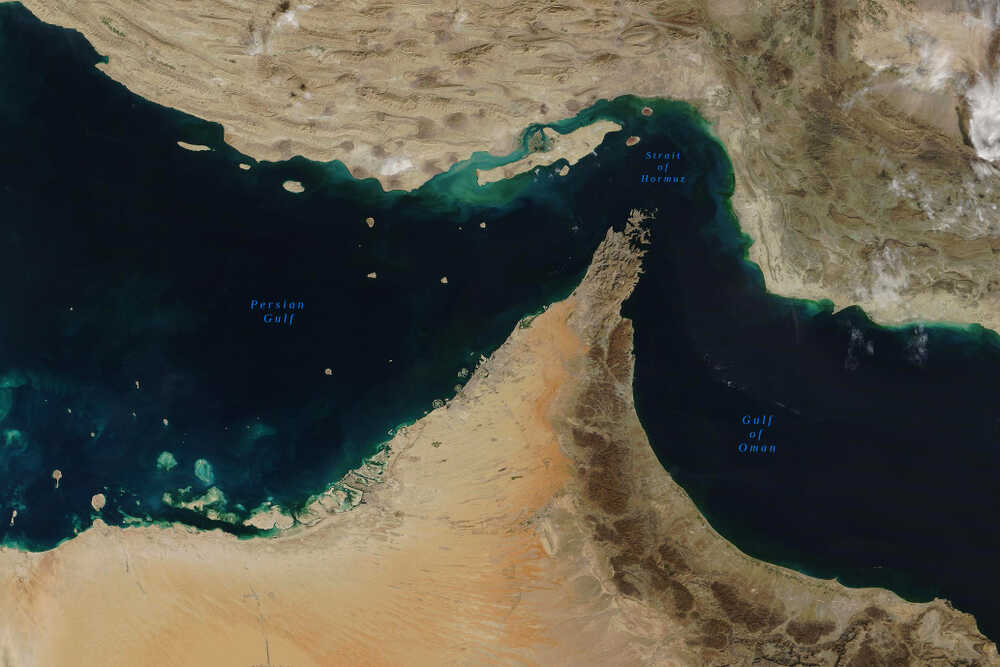
The strait’s importance is not academic. Roughly a third of global maritime oil trade transits Hormuz, and disruption can quickly ripple into fuel and shipping costs that hit American households. Reports in the available coverage describe Iranian actions as effectively shutting or severely disrupting passage after U.S.-Israeli operations began in late February. The immediate result has been higher oil prices and greater market uncertainty, which historically punishes working families through higher transportation and consumer costs.
Iran threatens infrastructure retaliation as the window closes
Iran did not treat the warning as empty rhetoric. Iran’s Khatam al-Anbiya Central Headquarters threatened to target U.S. and Israeli energy, information technology, and desalination infrastructure across the region if Iranian facilities are attacked. Iran’s foreign minister also warned Tehran would show “zero restraint” if its infrastructure is hit. Those statements matter because they outline what Tehran claims it could strike, and they frame the conflict around civilian-adjacent systems, not only military assets.
Separate reporting cited by Israeli officials describes Iran using long-range ballistic missiles with an approximate 4,000-kilometer range during the conflict, including launches toward the Diego Garcia base. If accurate, that capability broadens the risk envelope well beyond the immediate Gulf, and it helps explain why allies are watching closely even if they are hesitant to commit forces. The available sources do not provide independent technical verification of ranges, but they consistently describe the launches as a serious escalation.
Allies endorse free navigation, while Trump pushes burden-sharing
European allies and Japan issued a joint statement affirming commitment to freedom of navigation and safe passage through the strait, pointing to international law principles. That diplomatic support is significant because it places public emphasis on the rules-based argument against coercive closure of sea lanes. At the same time, Trump’s prior comments criticized NATO partners for reluctance to take on real risk, reflecting his long-running demand that wealthy allies contribute more than statements and symbolism.
That tension—global dependence on U.S. hard power paired with uneven allied participation—sits at the center of Trump’s approach. The public messaging also signals that the administration sees Hormuz not as a niche regional dispute but as a core national interest issue tied to energy stability and shipping security. For many Americans who remember years of “global leadership” talk paired with domestic pain at the pump, the key question is whether partners will materially help keep the lane open.
What’s known, what’s disputed, and what happens next
Several facts in the reporting align across outlets: Trump issued a time-bound ultimatum; the demand is reopening the strait fully and “without threat”; and Iran responded with explicit retaliation warnings. Other details are less firm. One commonly repeated claim—casualty totals from the initial late-February strikes, including reports about Iranian leadership losses—appears in coverage but is not independently substantiated in the provided materials, so it should be treated as unverified context rather than settled record.
The 48-hour timeline creates a forced choice: Iranian compliance, a negotiated off-ramp, or kinetic escalation targeting infrastructure. Strikes on power generation would be a major step because civilian impact can expand quickly, even when the target is framed as strategic. With energy prices already sensitive to disruption, the stakes extend far beyond the region. The conservative concern is straightforward: sea-lane security is essential, but open-ended commitments and vague allied support have a long history of leaving Americans to carry the cost.