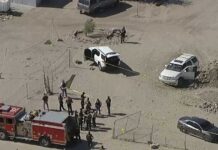


When cartel gunmen can roll into a small town and riddle a police headquarters and nearby homes with bullets before dawn, it’s a blunt reminder of how fast basic public order can collapse.
Story Snapshot
- An armed group attacked the municipal police station in Trinidad García de la Cadena, Zacatecas, and also hit nearby homes and patrol units.
- Authorities reported multiple bursts of gunfire, damage to at least two patrol cars, and a home’s facade struck by rounds.
- Preliminary information from the state prosecutor’s office indicated one person was killed.
- Mexican Army, National Guard, state public security, and state investigators moved in to establish a security base and reinforce vigilance.
Pre-dawn assault targeted police and civilians
Residents in Trinidad García de la Cadena, a rural municipality in Zacatecas bordering Jalisco, reported that armed men arrived in trucks and opened fire, escalating again shortly before 5 a.m. The attackers targeted the municipal police headquarters and also struck nearby homes, leaving visible damage. Reports indicated at least two patrol cars showed bullet impacts. Officials later confirmed a preliminary fatality linked to the aggression.
Local accounts described a pattern typical of “hit-and-run” cartel tactics: rapid entry, concentrated shooting, and withdrawal before local forces can mount a coordinated response. In this case, the lack of reported drones or explosive devices stood out compared with other recent Zacatecas incidents, but the message was similar—municipal police outposts can be pressured or overwhelmed, and ordinary families living near government facilities can become collateral targets.
Federal reinforcements reveal stress on local policing
Responding agencies quickly included Mexico’s Army and National Guard alongside Zacatecas state public security officials and the state attorney general’s office, which established a base in the area. That multi-agency posture signals both urgency and a familiar reality in Mexico’s security map: small municipal departments often lack the manpower, intelligence capacity, and equipment to deter organized crime without outside support. The state prosecutor’s office described the death as preliminary, underscoring that early facts can evolve.
The incident also highlights why cartel violence is not merely a “crime story” but a governance story. When gunmen can challenge a police command post and strike civilian property in the same episode, trust in public institutions erodes fast. For Americans watching from across the border, the practical concern is spillover risk—displacement, trafficking routes, and cross-state criminal logistics—especially when violence concentrates in corridor regions prized for moving drugs and extorting businesses.
Zacatecas sits at the crossroads of competing cartels
Zacatecas has faced intensifying cartel violence since 2020, driven by turf fights involving factions linked to the Sinaloa Cartel, the Jalisco New Generation Cartel (CJNG), and local groups. Trinidad García de la Cadena’s location along the Jalisco border matters because border municipalities can function as launch points for incursions and retreats across state lines. In this case, sources described the attackers as organized crime, while any cartel attribution remained uncertain based on available public reporting.
That uncertainty is important. Some coverage has suggested CJNG involvement because of geography and the broader pattern of intimidation against police, but the incident reporting still treated the perpetrators as an unspecified armed group. Without a formal attribution supported by arrests, seized communications, or an official statement naming a group, the responsible posture is to treat cartel identity as unconfirmed—even if the strategic logic of the region makes certain suspects plausible.
Earlier explosive attacks show an evolving threat picture
Separate reporting on Zacatecas earlier in 2026 documented explosive attacks against police installations, including an alleged car bomb incident in Luis Moya that injured officers and damaged homes and infrastructure. Another reported explosive attack injured three in a different case. Those episodes point to tactical evolution in parts of the state—moving beyond small-arms fire to explosives—yet the Trinidad García de la Cadena attack appeared to rely on vehicles and firearms rather than bombs or drones.
For citizens on both the right and left in the U.S. who already distrust distant institutions, the takeaway is less about partisan talking points and more about state capacity. Whether the governing ideology is left or right, public safety is the first job of government. When local governments cannot secure police facilities or protect nearby households, federal power inevitably expands to fill the vacuum—often late, and often at higher cost.
What happens next will depend on whether authorities can sustain presence after the immediate surge. A short-term security base can calm a town for days, but long-term deterrence requires consistent policing, credible investigations, and protection for local officers and witnesses. The available reporting does not yet provide details on arrests, confirmed suspect identities, or a final casualty accounting beyond the preliminary fatality, so the most defensible conclusion for now is limited: the attack reflects a continuing pattern of cartel pressure on rural institutions in strategic border zones.
Sources:
https://ground.news/article/car-bomb-attack-in-luis-moya-zacatecas-what-is-known
https://www.borderlandbeat.com/2026/04/attack-on-police-station-and-homes-in.html?m=1