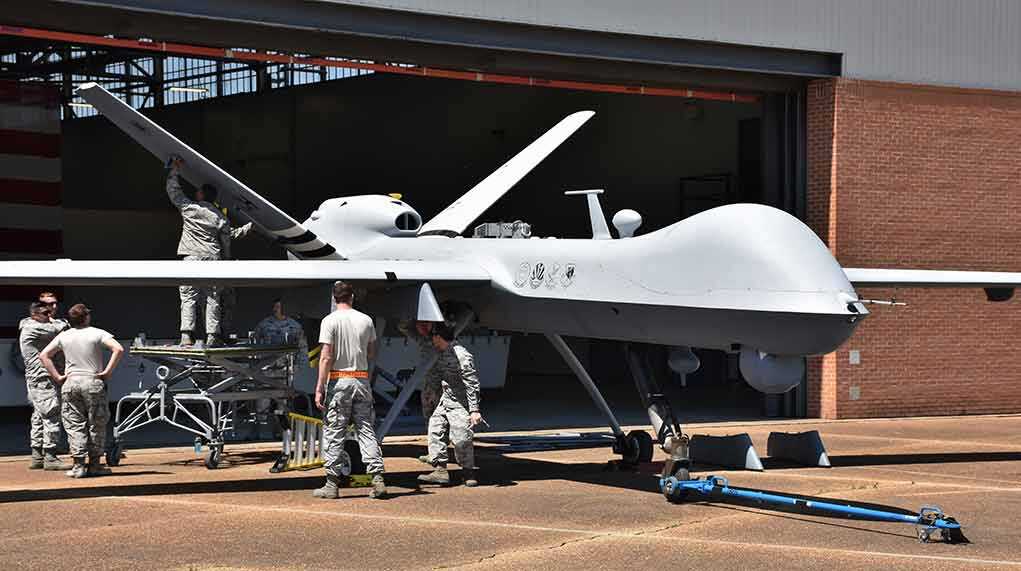
Washington’s budget push for autonomous warfare marks the largest U.S. drone investment on record, signaling a rapid shift to American-made systems and mass production.
Story Highlights
- Pentagon carved out $13.4 billion for autonomy in 2026, including $9.4 billion for aerial drones.
- The 2027 request scales to about $54 billion for autonomous and related systems.
- Plan includes funds to expand U.S. drone industrial capacity and speed delivery.
- Watchdogs warn past drone programs struggled with cost, schedule, and sustainment.
Pentagon Sets Record Funding To Field Autonomous Systems
Defense leaders outlined a dedicated autonomy line in the fiscal year 2026 budget, totaling $13.4 billion. Officials said $9.4 billion targets unmanned and remotely operated aerial vehicles, with the rest for sea, ground, and enabling software. This was the first time the autonomy category stood alone in the request, showing a shift toward large-scale drone procurement and integration across the force. Reports describe this as part of a broader modernization plan focused on speed and scale.
Budget documents and public briefings signal an even bigger leap in fiscal year 2027. The Defense Department is seeking roughly $53.6 billion for autonomy, drone platforms, and contested logistics, alongside tens of billions for munitions and counter-drone systems. The aim is to equip units faster, build stockpiles, and prepare for high-end conflict where attritable drones and software-driven teaming matter most. This step would dwarf prior drone investments by a wide margin.
Industry Impact: Demand For NDAA-Compliant, Scalable U.S. Drones
The spending plan includes money to boost the domestic drone industrial base, limit foreign dependence, and speed deliveries. Reports cite $1.4 billion aimed at expanding U.S. production and $500 million to prevent delays in critical drone fielding. Companies that meet National Defense Authorization Act compliance and can scale quickly stand to benefit as services buy more small systems, loitering munitions, and collaborative combat aircraft to meet near-term needs.
Congressional analysts note that selected aircraft and related systems already account for tens of billions in annual requests. The new autonomy push layers on top of those programs, pointing to a multi-year supercycle if appropriators fund the requests. The drone buys reach across services and mission sets, from base defense and intelligence to strike and electronic warfare. This breadth could stabilize orders for American factories if schedules hold and testing stays on track.
What Conservatives Should Watch: American Strength, Waste Risks, And Speed
Defense leaders say the goal is simple: field American-made drones at scale so troops win and come home safe. That fits core conservative priorities—peace through strength, a secure border, and supply chains anchored in the United States. The plan also backs counter-drone tools to protect bases, critical sites, and towns from hostile swarms. If built here, with strong security rules, these funds can harden the homeland and deter enemies who rely on cheap mass attacks.
Government watchdogs have warned for years that drone programs often slip on cost, training, and sustainment. Past efforts lacked common parts, open systems, and clear long-term plans, which slowed fielding and drove waste. Those lessons are fresh reminders as money scales up again. Success will depend on clear requirements, rapid testing, and contracts that reward on-time delivery and performance, not paperwork and endless studies that pad costs.
Strategic Stakes: Win The Drone Fight Or Fall Behind Rivals
Recent conflicts proved that drones shape the modern battlefield. Units that sense, strike, and jam faster gain the edge. The United States is now setting budgets that match that reality. The focus on autonomy, teaming, and counter-drone layers aims to outpace adversaries who flood the sky with cheap systems. If the plan holds, troops could get smarter swarms, better targeting, and stronger air defenses at the point of need, not years later.
The path forward is clear. Keep the buys American. Scale factories. Enforce National Defense Authorization Act rules. Use open systems so parts and software plug and play. Tie payments to real deliveries. That approach serves the warrior and the taxpayer. It builds strength without feeding waste. And it sends a message: under President Trump, the United States intends to lead the drone era with speed, skill, and steel made at home.
Sources:
zerohedge.com, theguardian.com, us-dg.com, insidedefense.com, gao.gov