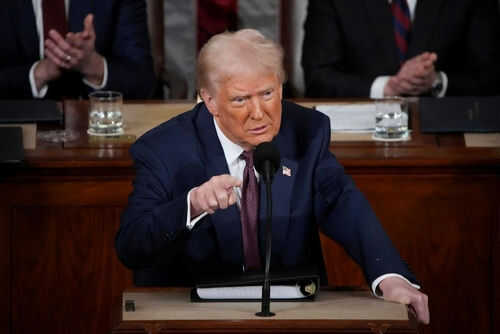
President Trump’s blunt claim that the Iran war is “very complete” is colliding with Pentagon caution—and the gap matters because Americans deserve clarity when U.S. power is on the line.
Story Snapshot
- President Trump told CBS News the U.S.-Israel campaign has crippled Iran’s navy, communications, and air force, predicting the war will end “very soon.”
- Trump repeated the message publicly but also stressed the fight is not fully finished, promising continued pressure until Iran’s leadership is defeated.
- TIME reported the Pentagon signaled a longer campaign, creating a visible contrast in tone and expectations.
- Iran’s leadership transition following Ayatollah Ali Khamenei’s death adds uncertainty to how and when the conflict de-escalates.
Trump’s “Very Complete” Remark and What He Said Was Destroyed
President Donald Trump described the U.S.-Israel war effort against Iran as “very complete, pretty much” during a phone interview with CBS News from Doral, Florida. Trump said Iran has “no navy, no communications,” and “no air force,” framing the campaign as nearing its end. His comments came as the conflict moved through its second week, following strikes aimed at Iran’s military infrastructure and strike capabilities.
Trump carried that message into the same day’s political and press settings, but his language shifted depending on the audience and the moment. At a gathering with Republican lawmakers at a House policy retreat in Florida, Trump emphasized that more work remains and pledged to keep applying pressure. At a later press conference, he again said the operation was “pretty well complete,” yet also suggested it would not end this week, only “very soon.”
Pentagon vs. White House Tone: Why Mixed Messaging Fuels Uncertainty
TIME reported a sharper contrast inside the administration’s broader posture, quoting the Pentagon’s line that “We have only just begun to fight.” That difference does not automatically mean disagreement on objectives, but it does create two competing public expectations: quick closure versus an extended campaign. For voters weary of years of foreign-policy drift, messaging discipline is not cosmetic—it shapes deterrence, reassures allies, and signals resolve to adversaries.
Trump’s own remarks captured that tension: he projected dominance while also insisting the U.S. and its allies had not “won enough” yet. The available reporting does not provide independent verification for each battlefield claim, and the timeline remains fluid. What is clear is that Americans are hearing both “near the end” and “just beginning” from the same national-security apparatus, which can complicate public understanding and congressional oversight.
Iran’s Leadership Shake-Up Raises the Stakes for an Endgame
The conflict is unfolding amid a dramatic power transition in Tehran. After Ayatollah Ali Khamenei’s death, Iran named his son, Mojtaba Khamenei, as the new supreme leader, according to the reporting summarized by TIME. Trump expressed disappointment at that succession and signaled he expects continuity rather than reform. Leadership transitions can tighten internal control or trigger instability; the current reporting does not establish which direction Iran is heading.
Meanwhile, TIME relayed significant casualty figures attributed to officials and aid organizations: Iran’s Red Crescent reported about 1,300 deaths, and the report also described fatalities from Iranian attacks as well as heavy losses and displacement in Lebanon as fighting expanded. Those numbers underscore the human cost and the regional spillover risk. They also explain why “very soon” is doing a lot of work in public messaging when conditions on the ground remain volatile.
What Conservatives Should Watch: Objectives, Limits, and Constitutional Accountability
The reporting described shifting or overlapping stated goals—preventing nuclear escalation, protecting allies, and forcing regime change—alongside Republican applause for escalation at Trump’s event. For a conservative audience that prioritizes limited government and constitutional guardrails, the key question is whether the administration clearly defines an achievable objective and a stopping point. A decisive strategy can deter threats; unclear aims can invite mission creep and prolonged commitments.
Trump framed the campaign as a short-term effort to eliminate a major threat, while analysts quoted by TIME warned the trajectory could become longer and deadlier. With oil markets and global security sensitive to Middle East shocks, Americans should track whether official briefings align with operational reality. If the war is truly nearing completion, the next test will be stabilization—ensuring Iran cannot rapidly reconstitute capabilities and that U.S. interests are protected without open-ended escalation.
Sources:
Trump says war on Iran will end ‘very soon’, calls conflict ‘very complete’