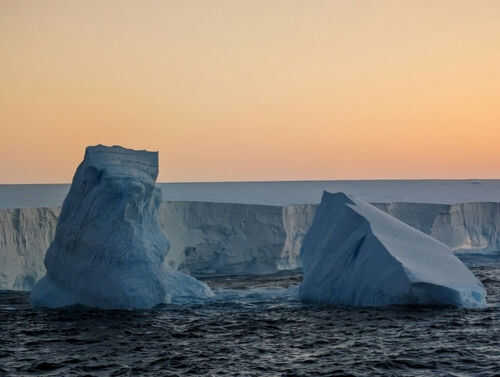
Scientists warn a key Antarctic ice shelf that props up the so‑called “Doomsday Glacier” is fracturing toward failure, yet media hype obscures what is known, what is uncertain, and what actually matters for American families.
Story Highlights
- Researchers document rapid weakening of Thwaites Glacier’s eastern ice shelf and rising fracture-driven acceleration [2].
- Field programs confirm warm ocean pulses can undercut shelves from below, intensifying melt episodes [3].
- Thwaites is losing tens of billions of tons more ice each year than snowfall replaces, and its full collapse would raise seas about 65 centimeters, over a long horizon [4].
- Scientists dispute how quickly shelf loss translates into major retreat, and timing claims vary widely in secondary sources [1].
Evidence of a Weakening Buttress at Thwaites Glacier
Two decades of satellite tracking and on-ice Global Positioning System instruments show the Thwaites Eastern Ice Shelf has developed fractures in a shear zone while losing its grip on a stabilizing pinning point, a configuration scientists link to faster ice flow and further damage in a reinforcing loop [2]. Researchers describe this floating shelf as a brace that restrains the eastern side of the glacier, meaning its degradation reduces back-pressure on grounded ice that ultimately drives sea-level contribution [1].
Program literature focused on Thwaites emphasizes that the glacier is already shedding far more ice than it gains, with annual losses on the order of about 50 billion tons beyond snowfall, and that this imbalance has roughly doubled when compared with the situation three decades ago [4]. Those same materials state that if the glacier were to collapse entirely—an outcome considered over long timescales—global sea levels would rise by about 65 centimeters, underscoring why engineers and coastal planners track this system even while near-term dynamics remain uncertain [4].
Ocean Heat Pulses and Sub-Ice Undercutting
Oceanographers report that short-lived warm-water surges can attack the underside of Antarctic ice shelves, producing melt episodes that occur on day-to-week intervals rather than only over seasons or years [3]. High-resolution moorings and autonomous floats recorded distinct warming events that matched model-identified pulses, connecting observed heat bursts to rapid basal melting under shelves like those adjacent to Thwaites [3]. These findings support the mechanism in which ocean variability, not just air temperature trends, helps destabilize floating ice platforms that buttress grounded glacier fronts [3].
Prior summaries further note that the Thwaites ice shelf currently helps restrain the glacier’s eastern flank by distributing stress and damping calving, so loss of this floating brace could allow existing rifts and crevasses to propagate more readily [1]. However, while that mechanical picture is broadly accepted, competing studies debate how much additional acceleration follows immediately after a shelf break and whether marine ice cliff instability dominates the response or plays a limited role under realistic ice strength conditions [1].
Sorting Hype from Uncertainty on Timing and Impact
Public-facing coverage often compresses three distinct ideas—thinning shelves, retreating grounding lines, and global catastrophe—into a single dramatic claim, but the underlying research is more careful about timelines and magnitudes [1]. The collaboration’s own updates acknowledge major unknowns in forecasts, and while some communications suggest the eastern ice shelf could break up and drift away in coming years, the packet here does not include a single dated primary-source forecast with a precise schedule for that failure, which limits confidence in specific countdown headlines [1].
— Thwaites Glacier —
The parallel rift quite far upstream in the central ice sheet is causing concern for only a handful of scientists. However, the likelihood of a chain reaction in which the central part loses its outward pressure towards the TWIS and TEIS is very high. pic.twitter.com/AXdaVWSBgV
— Kris Van Steenbergen (@KrVaSt) May 18, 2026
For conservative readers balancing stewardship with common sense, the priority is straight facts over alarmism: the shelf is weakening [2], ocean heat pulses are a proven driver [3], Thwaites is a significant long-term sea-level source [4], and the immediate jump in discharge after a shelf break remains contested in the literature [1]. Policymakers should demand transparent sourcing, distinguish near-term infrastructure risk from century-scale projections, and ensure spending targets practical resilience—ports, bases, and coastal defenses—without giving cover to bloated climate slush funds or ideologically driven agendas unrelated to measurable risk.
Sources:
[1] Web – Thwaites Glacier – Wikipedia
[2] Web – Satellites spot rapid “Doomsday Glacier” collapse | ScienceDaily
[3] Web – Undersea “Storms” Are Melting Antarctic Glaciers from Below
[4] Web – Thwaites Glacier Facts