As Operation Epic Fury unfolds, the biggest question for Americans isn’t just what was hit in Iran—it’s who, exactly, gets to authorize a new major military campaign.
At a Glance
- President Trump monitored the opening phase of the U.S.-Israel strikes from Mar-a-Lago while Vice President JD Vance coordinated from the White House Situation Room.
- Secretary of State Marco Rubio briefed seven of the eight “Gang of Eight” congressional leaders before strikes began, according to the White House.
- The Pentagon described the operation as the largest regional concentration of U.S. military firepower in a generation, including the first combat use of low-cost one-way attack drones.
- Democratic leaders criticized the action as an “act of war” without formal authorization, while Republican leaders praised it as a necessary response to Iranian threats.
Photos, Command Posts, and a Split-Screen Presidency
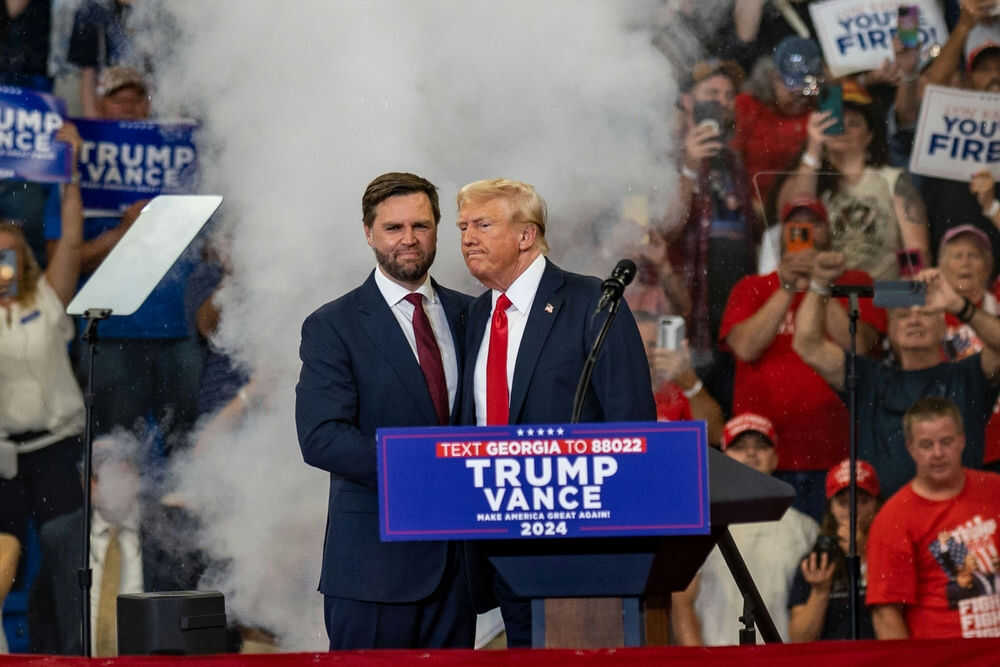
The White House released imagery showing a divided but connected command structure during the early hours of Operation Epic Fury: President Donald Trump at Mar-a-Lago with senior advisers, and Vice President JD Vance inside the White House Situation Room with top national security and economic officials. Reporting indicates Vance stayed on a conference line with Trump’s Florida team as strikes began, underscoring that the operation was directed through established national-security channels even while Trump remained in Florida.
The operational labels also signaled how closely Washington and Jerusalem worked together. U.S. forces used the name “Operation Epic Fury,” while Israel referred to “Operation Roaring Lion,” with both sides describing coordinated precision strikes conducted from air, land, and sea. The public details available so far emphasize timing, coordination, and scale, but provide fewer specifics on target sets, bomb damage assessments, or the exact triggers that moved planning into execution.
What the Administration Said It Is Trying to Achieve
President Trump’s overnight video message described a multi-phase campaign with blunt objectives: destroy Iran’s missile capabilities and missile industry, cripple Iran’s navy, and reduce the ability of Tehran’s regional proxies to destabilize the Middle East. Administration officials framed the operation as defensive and tied to what they called “imminent threats,” while also highlighting Iran’s missile posture as an intolerable danger to U.S. forces and allies. Those claims remain central to the policy justification.
The backdrop is a familiar pressure cycle: stalled talks, military positioning, and demands for “NO NUCLEAR WEAPONS.” Earlier statements tied the administration’s posture to nuclear and regional concerns, and later reporting highlighted frustration that Iran would not negotiate over ballistic missiles. The result is a rapid shift from diplomatic leverage to kinetic action, a pivot that supporters see as deterrence and critics see as escalation, depending largely on how “imminent threat” is substantiated publicly.
Congress, War Powers, and the “Gang of Eight” Briefing
The administration points to pre-strike outreach as proof it followed the rules. The White House confirmed Rubio briefed seven of the eight “Gang of Eight” leaders before the operation began. That matters because those members are routinely notified for the most sensitive national security actions. Still, notifying select leadership is not the same as a public vote, and Democrats immediately argued the strikes amounted to war-making that requires congressional authorization under the War Powers framework.
From a constitutional perspective, the dispute lands on a basic tension Americans have watched for decades: presidents of both parties act quickly abroad while Congress debates after the fact. The available reporting does not resolve whether the operation fits existing authorizations or requires a new one, and that uncertainty is exactly why war-powers fights become so heated. For voters already tired of government “process games,” the key issue is whether accountability rises with the scale of action.
Scale, Technology, and the Risk of Mission Creep
Pentagon descriptions of the opening phase portrayed a historic level of force in the region—reportedly the largest concentration of American military firepower in a generation—paired with modern tools like low-cost one-way attack drones used in combat. Those details matter because they suggest the operation was not a symbolic strike but a campaign designed to unfold over time. A multi-phase posture raises the stakes for oversight, clarity of objectives, and defined off-ramps.
Casualty reports illustrate why information discipline matters in wartime. Iranian state media offered varying figures, including claims of dozens killed at a girls’ school and broader claims of more than 200 dead and hundreds wounded, while independent verification was not available in the early reporting and U.S. and Israeli officials did not immediately respond to questions on civilian harm. In practice, disputed casualty narratives often become propaganda fuel, complicating diplomacy and public support.
Politically, the early reaction followed predictable lines: Republican leaders praised the strikes as necessary against Iranian threats, while Democratic leaders demanded War Powers enforcement and deeper briefings. That divide is unlikely to fade soon, especially given Trump’s long-running promise to avoid “endless wars.” The facts available so far show a major operation with big stated goals and limited public detail on imminence—conditions that make congressional scrutiny and transparent objectives crucial for sustaining legitimacy.
Sources:
Operation Epic Fury: Most Dems criticize Trump while Republicans praise president
Trump gives in to the temptation of regime change in Iran with Operation Epic Fury
Lawmakers, world react to US strikes against Iran
The latest: Trump believes reporting that Iran’s supreme leader is dead is correct
Israel, US attack Iran; Trump says major combat operations (Live updates)