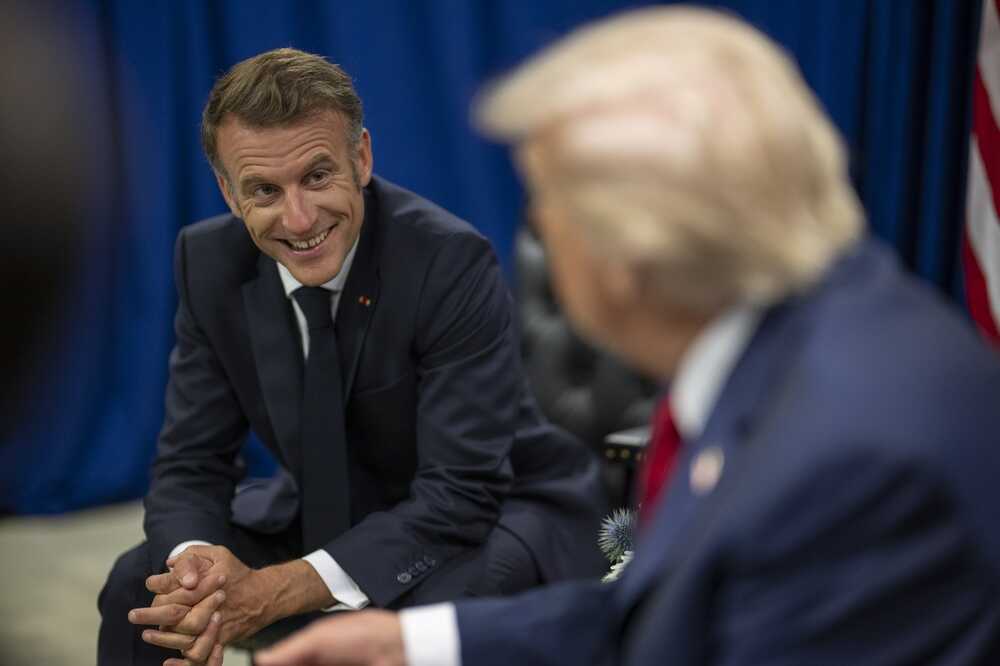
Trump’s off-the-cuff jab at France’s president is colliding with a far bigger problem: Americans who voted to end forever wars are now watching the White House pressure allies for help in a new Middle East fight.
Story Snapshot
- President Trump mocked French President Emmanuel Macron during a private lunch, referencing a viral 2025 video involving Brigitte Macron and calling NATO a “paper tiger.”
- The remarks came as Trump criticized France and other allies for refusing to provide military support for U.S.-led operations against Iran.
- A White House YouTube video reportedly captured the comments, but it was briefly posted and then blocked, leaving the full context hard to independently verify.
- The episode highlights growing tension inside the MAGA coalition over U.S. involvement abroad, energy costs, and whether allies are carrying their share.
Leaked lunch remarks mix personal insult with NATO pressure
President Donald Trump used a private lunch to criticize French President Emmanuel Macron while pressing France to support U.S.-led military operations related to the Iran war. Reports say Trump mocked Macron by claiming his wife “treats him extremely badly” and joked that Macron was “still recovering from the blow to the jaw,” a reference to a viral May 2025 video from Vietnam. Trump also imitated Macron’s accent while dismissing NATO’s reliability.
The timing matters because the insult wasn’t delivered as a stand-alone joke; it was paired with Trump’s frustration that allies would not commit ships or other support to Gulf operations. According to reporting, Trump described reaching out for assistance and being turned down with assurances along the lines of “after the war is won.” That framing casts the exchange as a pressure tactic—public ridicule used to extract military help from a reluctant partner.
What’s confirmed—and what remains uncertain—about the video
Multiple outlets carried similar quotations, but the original White House video was reportedly uploaded briefly and then blocked, limiting verification of surrounding context. That means the core lines attributed to Trump are widely repeated, yet the full exchange—who else was present, what was asked, and what was cut—cannot be evaluated from the blocked upload alone. No detailed French response was reported in the provided material at the time the story circulated.
The backstory to Trump’s “blow to the jaw” line traces to the May 2025 Vietnam trip clip in which Brigitte Macron appeared to push or slap Macron’s face. Macron publicly dismissed interpretations of the incident as disinformation, and the clip also fueled online rumors about the Macrons’ marriage that have been repeatedly disputed. Trump had previously commented more lightly on the incident in 2025, advising Macron to “keep the door closed” on planes.
Iran war politics: allies say “no,” and voters ask why America is in
The reports tie Trump’s Macron mockery to the administration’s efforts to widen support for U.S. operations against Iran while American strikes reportedly continue at a heavy pace. For many conservative voters, that combination hits a nerve: they remember campaign promises about ending regime-change missions, and they are watching Washington revert to a familiar playbook—escalation abroad paired with demands that allies “do more,” while U.S. taxpayers carry the bulk of the cost.
The disagreement also exposes a strategic contradiction. Trump’s argument, as described in the coverage, is that NATO partners should step up because the U.S. is doing the work and allied security is at stake. Critics inside the broader right counter that the first question is not how to divide burdens, but whether the mission is defined, constitutional, and limited. The provided sources do not detail congressional authorization, war aims, or an end state, leaving key accountability questions unanswered.
Why the “paper tiger” label lands differently in 2026
Trump’s “paper tiger” characterization of NATO fits a long-running dispute over defense spending and burden-sharing that predates his second term. Yet in 2026 it lands against a new political reality: MAGA voters are divided not only on NATO, but on the wisdom of deeper involvement in the Middle East and on how far U.S. policy should align with allied priorities, including Israel’s security needs, when American families face high costs at home.
From a conservative perspective, the most consequential part of the story is less the personal jab and more the policy pressure behind it. When a White House tries to shame allies into joining an expanding conflict, it signals the conflict may be broader—or harder to sustain—than officials admit. The reporting provided does not offer a clear breakdown of France’s conditions or what specific assets were requested, but it does show the administration publicly framing refusal as weakness.
Sources:
Trump mocks Emmanuel Macron: His ‘wife treats him extremely badly’
Trump takes a dig at Macron, saying wife treats him ‘badly’