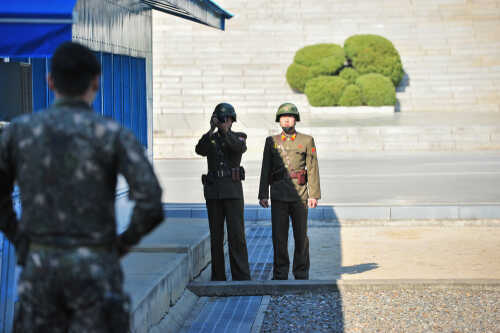
A North Korean man’s daring breach of the high-security Demilitarized Zone (DMZ) into South Korea raises questions about his motives and highlights growing tensions in the Korean Peninsula.
At a Glance
- A North Korean man crossed the DMZ into South Korea, triggering security concerns.
- The unarmed man was guided through minefields by South Korea’s military.
- Motives remain unclear if it’s a defection or other reasons.
- Tensions continue under South Korea’s new liberal government approach.
Crossing the DMZ: An Extraordinary Feat
The DMZ, a heavily fortified strip of land between North and South Korea, was breached by a North Korean man who crossed into South Korea custody. This incident took place in the central-west portion of the border, an area riddled with land mines. “A North Korean man walked across one of the most dangerous borders in the world and into South Korean custody late Thursday.” – The Associated Press.
North Korean man crosses heavily fortified border into South Korea https://t.co/ghKktCBvZf pic.twitter.com/C5CP3QZhpY
— New York Post (@nypost) July 5, 2025
South Korean soldiers tracked and guided the man safely through the perilous terrain. The American-led United Nations Command was informed, but no unusual activity from the North was detected. This crossing comes at a time of heightened sensitivity and strained relations between the Koreas.
Watch: North Korean Man Crosses Heavily Fortified Border into South Korea
A Questionable South Korean Stance?
Since assuming office, South Korea’s President Lee Jae Myung has attempted to ease tensions with Pyongyang by ceasing loudspeaker broadcasts and banning balloon launches of pro-democracy leaflets. This softer stance has faced criticism, with detractors suggesting it weakens deterrence against North Korea. Meanwhile, North Korea itself is reported to have launched balloons laden with trash into the South, adding more provocation to the simmering discord. “Since taking office June 11, South Korea’s liberal president, Lee Jae Myung, has taken steps to ease friction with Pyongyang. He halted loudspeaker broadcasts that blasted messages into the North and moved to ban balloon launches by activists carrying pro-democracy leaflets,” according to The Associated Press.
North Korea’s recent activities represent a broader pattern of provocation that hasn’t gone unnoticed. With an expanding nuclear arsenal and vocal threats against Seoul and Washington, tensions have never been higher, exacerbated by stalled diplomatic talks since 2019.
The Road Ahead: Treading Cautiously
South Korea’s current administration appears committed to maintaining open lines of communication with the North, aiming for peace via diplomacy. “Completely cutting off dialogue is really a foolish thing to do.” – Lee Jae-myung. Yet, as incidents like these rise in frequency, the question remains whether this openness is perceived as weakness or a genuine bridge for peace.
In this intricate web of international relations and internal strategies, both nations continue to walk a thin line. Time will tell if Lee’s dreams of peaceful cooperation can materialize into any tangible benefits. Until then, the South remains vigilant.