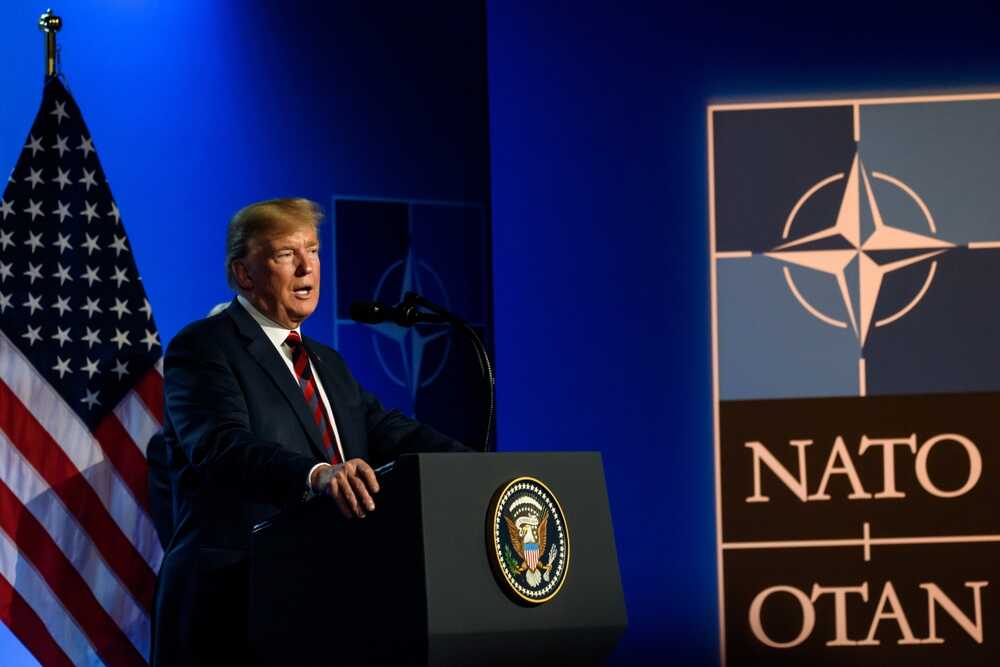
President Trump’s persistent threats to cripple NATO expose America’s overburdened role in defending free-riding allies, forcing Europe to confront its dependence on U.S. taxpayer dollars amid rising Russian threats.
Story Highlights
- Trump demands fair burden-sharing, as U.S. funds 62% of NATO while allies lag on spending commitments.
- Congress blocks unilateral exit, but presidents can withdraw troops and withhold support, hollowing out the alliance.
- Europe ramps up defenses with €800B ReArm plan and NATO’s new 5% GDP target by 2035, preparing for reduced U.S. involvement.
- Without U.S. nuclear umbrella and enablers, Article 5 deterrence crumbles, emboldening adversaries like Russia.
Trump’s America First Challenge to NATO
Donald Trump, now in his second term, renews calls for NATO allies to pay their fair share. The U.S. shoulders 62% of alliance funding and provides critical capabilities like satellite surveillance, missile defense, and airlift. European nations host U.S. troops in Germany and Poland, yet many fall short of even the 2% GDP defense spending goal. Trump’s rhetoric highlights decades of imbalance, where America subsidizes Europe’s security at the expense of domestic priorities like border control and energy independence.
Legal Barriers and Practical Workarounds
Congress passed the 2023 National Defense Authorization Act, requiring two-thirds Senate approval for any formal U.S. NATO exit. This bipartisan measure curbs unilateral presidential action under Article 13, which demands one-year notice. However, as commander-in-chief, the president retains authority to pull troops, skip exercises, and deny intelligence or nuclear commitments. Experts note this “hollowing out” evades legal hurdles while undermining Article 5’s collective defense promise, invoked once after 9/11.
Senator Thom Tillis (R-NC) warns of enormous risks to U.S. global leadership. European allies, facing Russian aggression in Ukraine, accelerate self-reliance. NATO’s 2025 summit pledged 5% GDP defense spending by 2035. The EU’s ReArm Europe initiative mobilizes up to €800 billion for independent capabilities, signaling preparation for a post-American alliance.
Historical Precedents and Stakeholder Dynamics
NATO formed in 1949 with 12 members, including the U.S., to counter Soviet threats via Article 5. France partially withdrew from military command in 1966 over sovereignty concerns but rejoined in 2009; no full exit has occurred. Today, 32 members rely on U.S. dominance. Trump pushes “America First” isolationism to cut costs and force burden-sharing. Congress asserts checks, while experts like Charles Kupchan argue presidents can effectively end the U.S. security umbrella.
Impacts on Security and U.S. Interests
Short-term troop withdrawals from Europe erode deterrence, risking Russian moves on Poland or the Baltics. Long-term, NATO transforms into a weaker Europe-led entity lacking U.S. enablers, diminishing American influence and forward bases. The U.S. saves billions but loses Navy projection and alliances in Asia. Europe faces anxiety, potential refugee surges, and booming defense industries. Both conservatives frustrated by overspending and liberals wary of elite foreign entanglements see a failing system prioritizing globalism over American workers.
This scenario underscores shared bipartisan distrust in bloated commitments that drain resources from pressing needs like inflation control and immigration enforcement. As elites debate abstractions, ordinary citizens demand government focus on the American Dream.
Sources:
Northeastern News: Trump Pulling Out of NATO Explained
Wikipedia: Withdrawal from NATO
The Week: What Would Happen if the US Left NATO