
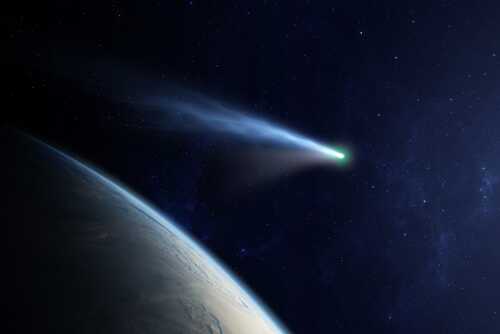
A mysterious interstellar visitor is “spraying” unknown material as it hurtles through our solar system, with Harvard physicist Avi Loeb suggesting it could be an alien craft powered by nuclear technology.
Story Highlights
- Third confirmed interstellar object 3I/Atlas exhibits unusual “spraying” behavior unlike typical comets
- Harvard’s Avi Loeb proposes the object could be an artificial alien craft with nuclear propulsion
- NASA confirms the object poses no Earth threat but continues intensive monitoring through October 2025
- Anomalous glow patterns and trajectory fuel scientific debate over natural versus artificial origins
Rare Interstellar Visitor Displays Unprecedented Activity
The ATLAS survey telescope in Chile detected object 3I/Atlas on July 2, 2025, marking only the third confirmed interstellar visitor after ‘Oumuamua and 2I/Borisov. The object originated from the direction of Sagittarius, traveling at 60 kilometers per second on a hyperbolic trajectory that confirms its interstellar origins. NASA tracking shows the visitor currently sits 416 million miles from the sun, approaching its closest point near Mars’ orbit by October 30, 2025.
Unlike typical asteroids, 3I/Atlas exhibits comet-like features including a faint coma and short tail, suggesting active outgassing or “spraying” of material. This behavior distinguishes it from previous interstellar objects and has prompted intensive observation campaigns by NASA, the Minor Planet Center, and international astronomical observatories. The Virtual Telescope Project plans live broadcasts to allow public viewing of this unprecedented cosmic event.
Watch: Massive interstellar object discovered by Hawaii-operated telescope
Harvard Physicist Proposes Artificial Origins
Harvard physicist Avi Loeb has publicly suggested 3I/Atlas could represent an artificial craft, potentially powered by nuclear technology from an advanced extraterrestrial civilization. Loeb points to the object’s anomalous energy patterns, unusual glow characteristics, and trajectory as evidence supporting non-natural origins. This proposal builds on his previous controversial claims about ‘Oumuamua, which also exhibited unexplained acceleration that defied conventional gravitational models.
The artificial origin hypothesis remains highly contested within the mainstream astronomical community. NASA and established observatories emphasize natural explanations, noting that the observed “spraying” behavior fits within known cometary physics, though with admittedly unusual characteristics. Most experts urge caution against premature conclusions, calling for more comprehensive data analysis before accepting extraordinary claims about alien technology.
In a magnified time-lapse, the interstellar wanderer 3I/ATLAS drifts like a ghostly ember through the glittering veil of Virgo's starry constellation.
This so called comet isn't playing around: Mountain-sized, tail-less speed demon from DEEP SPACE, jets shooting backwards,… pic.twitter.com/GgHDFW8PSo— Nibiru (@JinxedHorizon) October 10, 2025
Scientific Community Debates Unprecedented Findings
The discovery has intensified broader tensions within astronomy regarding openness to unconventional explanations versus adherence to established scientific models. While NASA maintains the object poses no planetary threat and will remain at safe distances, the ongoing debate reflects growing scrutiny of interstellar visitors following ‘Oumuamua’s mysterious properties. The current observational window through October 2025 provides a critical opportunity for real-time analysis of genuine interstellar material.
The implications extend beyond pure scientific curiosity, potentially influencing SETI research, planetary defense strategies, and space policy priorities. Advanced detection technologies like the ATLAS survey system have increased identification rates of fast-moving objects, suggesting more interstellar visitors may be discovered as monitoring capabilities expand. The resolution of 3I/Atlas’s true nature could establish precedents for evaluating future mysterious objects entering our solar system.
Sources:
NASA discovers mysterious interstellar object entering the solar system