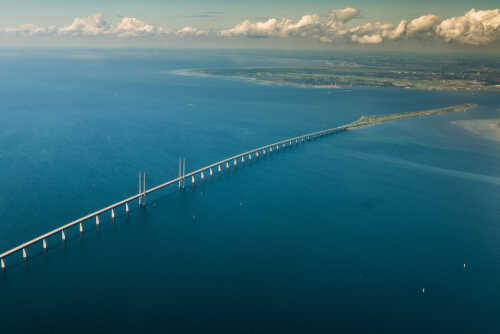
A remarkable engineering marvel connecting Denmark and Sweden demonstrates how innovative infrastructure can triumph over geographical challenges while preserving national sovereignty and environmental concerns.
Story Highlights
- The Øresund Bridge transforms from a 7.85-kilometer bridge into a 4.05-kilometer underwater tunnel via an artificial island
- Engineering masterpiece overcame WWII bomb disposal and maritime traffic concerns during construction from 1995-2000
- Structure reduced cross-border travel from hours-long ferry rides to 10-minute rail journeys
- Recent border control implementations contrast with the bridge’s original “borderless” vision amid migration concerns
Engineering Marvel Defies Natural Barriers
The Øresund Bridge stands as a testament to conservative principles of national cooperation without sacrificing sovereignty. Spanning the Øresund Strait between Copenhagen, Denmark and Malmö, Sweden, this hybrid structure begins as a traditional cable-stayed bridge from the Swedish coast, extends 7.85 kilometers to the artificial island Peberholm, then transitions into a 4.05-kilometer submerged tunnel beneath the Drogden fairway. This innovative design accommodates heavy ship traffic and Copenhagen Airport operations while maintaining each nation’s border integrity.
Construction teams overcame significant wartime obstacles during the 1995-2000 build period, including disposal of WWII-era bombs discovered on the seabed. Engineers also corrected a misaligned tunnel segment through precision adjustments, demonstrating the kind of problem-solving excellence that built Western civilization. The project finished three months ahead of schedule, a rare government infrastructure achievement that conservatives can appreciate for its efficiency and fiscal responsibility.
Watch:
Strategic Design Preserves National Interests
Architect Georg K.S. Rotne designed the “disappearing” aesthetic specifically to accommodate air traffic around Copenhagen Airport, proving that environmental and practical concerns can be addressed without abandoning ambitious projects. The artificial island Peberholm serves dual purposes as an engineering transition point and protected wildlife sanctuary, showing how development and conservation can coexist when guided by intelligent planning rather than radical environmental extremism.
The structure carries both the E20 highway and Øresund railway line, plus critical internet infrastructure connecting Scandinavia to broader European networks. This multi-functional approach maximizes taxpayer investment while strengthening regional economic ties through private enterprise and trade facilitation. The bridge represents the kind of strategic infrastructure investment that enhances national competitiveness without creating unsustainable debt burdens.
Border Security Challenges Modern Reality
While the bridge originally embodied Nordic cooperation ideals from the 1950s Nordic Council vision, recent developments highlight the tension between open borders and national security. Post-2015 migrant crisis concerns led to implementation of ID checks and enhanced border controls, demonstrating that even well-intentioned international cooperation must adapt to security realities that threaten citizen safety and national sovereignty.
Daily commuters numbering in the thousands continue using the crossing despite increased security measures, proving that legitimate cross-border commerce and travel can coexist with proper border enforcement. This balanced approach protects both economic benefits and national security interests, offering a model for how infrastructure can serve multiple priorities without compromising either effectiveness or safety through reasonable protective measures.
Economic Success Through Strategic Investment
The bridge transformed the Copenhagen-Malmö region into a major economic powerhouse, reducing travel times from hours to minutes while boosting trade, tourism, and industrial development. Cross-border employment opportunities expanded dramatically as workers could live in one country while employed in another, creating economic dynamism through market freedom rather than government intervention or artificial subsidies.
This success story demonstrates conservative economic principles in action: strategic infrastructure investment that facilitates private enterprise, reduces regulatory barriers to commerce, and strengthens regional competitiveness without creating permanent government dependency. The project paid for itself through user fees and economic growth, proving that well-designed public works can generate sustainable returns while serving genuine public needs rather than political vanity projects.
Sources:
A Short History of the Øresund Bridge – Nordics.info
The Øresund Bridge – The Aficionados