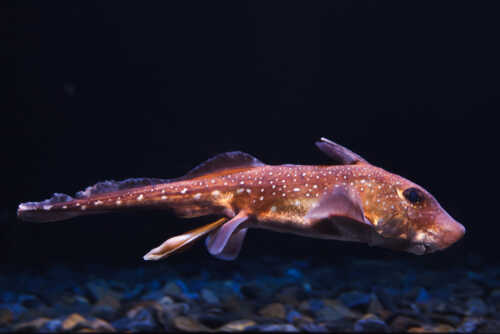
Teeth on a fish’s forehead have just shattered a centuries-old rule in biology—proving that evolution’s weirdest ideas are still lurking beneath the surface, waiting to bite the textbooks.
Story Snapshot
- Male spotted ratfish grow real teeth—not just scales—on a rod-like appendage on their foreheads, used exclusively for mating.
- This is the first confirmed case of true teeth growing outside the mouth in any living vertebrate.
- The finding overturns a foundational assumption in biology, revealing that tooth-forming genes can be activated far from the jaws.
- Researchers suggest this opens doors to undiscovered evolutionary surprises in other species.
The Day Biologists Realized Teeth Can Grow Anywhere
Male spotted ratfish, deep-sea relatives of sharks, have just rewritten the rulebook on what teeth are and where they belong. For years, scientists assumed teeth were strictly an oral affair—hard, enamel-tipped sentinels guarding the jaws of vertebrates. That assumption snapped when biologists from the University of Florida, University of Washington, and University of Chicago found real, bona fide teeth growing on the tenaculum, a rod-shaped structure protruding from male ratfish foreheads. These aren’t decorative scales or mere bumps; they are true teeth, with internal structure and genetic signatures matching those in the mouth, and they’re used for one purpose: clutching females during mating.
Watch: Forehead Teeth?! Fish Discovery Upends Evolutionary Dogma – YouTube
How a Deep-Sea Oddity Upended Textbook Biology
The discovery didn’t come out of nowhere. For decades, the evolutionary origins of teeth have been hotly debated, with sharks often serving as the model—teeming with both mouth teeth and tooth-like skin denticles. But the tenaculum teeth are different. They’re not just skin deep, or denticles masquerading as teeth. Micro-CT scans, tissue analysis, and fossil records spanning 315 million years confirm these are true teeth, complete with roots and layers, and they’ve been a feature of chimaeras (ghost sharks) since the age of coal swamps.
Scientists just found real teeth growing on a fish’s head – https://t.co/iMh2b9WL9M
— Ken Gusler (@kgusler) October 16, 2025
The researchers’ proof was as much genetic as it was anatomical. By confirming that the same developmental genes light up in both the ratfish’s mouth and its forehead, they established that vertebrate bodies can, under the right circumstances, grow teeth wherever those genes are switched on. This isn’t just a one-off freak of nature. It’s a demonstration that evolution’s toolkit is bigger and more unpredictable than previously imagined, and that “teeth” as a concept may reach further than anyone dared suggest.
Meet the Scientists Who Caught Evolution in the Act
Gareth Fraser at the University of Florida, Karly Cohen at the University of Washington, and Michael Coates at the University of Chicago led the charge. Their collaboration spanned paleontology, anatomy, and genetics, with essential specimen collection at the Friday Harbor Labs in Puget Sound. The team drew on support from the National Science Foundation and Save Our Seas Foundation, emphasizing how basic research still delivers headline-making discoveries.
Fraser summed up the shock: “If chimaeras can make a set of teeth outside the mouth, where else might we find teeth?” Cohen, equally astonished, said, “This insane, absolutely spectacular feature flips the long-standing assumption in evolutionary biology that teeth are strictly oral structures.”
What This Means for Science—and for Us
The implications stretch far beyond the dark waters of the Pacific. Textbooks will have to be rewritten, and scientists are now on the hunt for other vertebrates that may hide similar surprises. The finding energizes evolutionary biology, genetics, and marine science, sparking renewed interest in weird adaptations and the flexibility of developmental programs.
For now, the spotted ratfish’s forehead teeth serve as a bracing reminder: Evolution is less a tidy ladder than a wild workshop, where nature’s best ideas may bolt themselves onto the most unexpected places. As research continues, don’t be surprised if more creatures turn up with teeth in places nobody thought to look. In the end, science’s greatest revelations often come not from what we expect, but from where we never bothered to check.
Sources:
ScienceDaily: “Ghost sharks grow teeth on their heads to mate”
Popular Science: “Forehead Teeth?! Fish Discovery Upends Evolutionary Dogma”
OPB: “Ratfish teeth forehead University of Washington”
Smithsonian Magazine: “This Deep-Sea Fish Has Teeth on Its Forehead—and It Uses Them for Sex”