China’s Shenzhou-23 launch is not just another rocket show; it is Beijing’s quiet bid to master one-year human spaceflight and lock in a permanent foothold over our heads.
Story Snapshot
- Three astronauts ride Shenzhou-23 to China’s Tiangong space station for a six-month rotation, with one slated to stay a full year [3].
- The mission showcases a maturing launch machine: precise timing, practiced crews, and a workmanlike space station routine.
- Over 100 experiments aim to turn Tiangong into a high-orbit laboratory, not a mere political billboard [3][6].
- A Hong Kong payload specialist on board projects a carefully curated image of “national unity” alongside technological prowess [6].
China’s Next Space Commute Is Really A Long-Duration Dress Rehearsal
Shenzhou-23 looks, on the surface, like a routine crew rotation: three astronauts, one Long March 2F rocket, and a six-month stay on the Tiangong space station. Dig a little deeper and you find the real story tucked into the mission profile—one crew member is expected to remain on orbit for about a year, stretching China’s human-spaceflight endurance record and inching its program closer to parity with the year-long stays that Americans and Russians treat as the benchmark for serious spacefaring nations [3].
The China Manned Space Agency scheduled liftoff for 23:08 Beijing time, 15:08 Universal Time, from the Jiuquan Satellite Launch Center in the Gobi Desert [3]. The timing matches airspace closure notices and international launch calendars that have started treating these Chinese crewed flights as predictably as an airliner departure [1]. That kind of regularity matters: it signals that Tiangong is not an occasional stunt outpost, but a continuously staffed platform that can be planned around years in advance, like the International Space Station once was.
The Crew: One Veteran, One Pilot, And One Political Signal
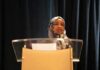
The official crew list reads like a carefully balanced portfolio: commander Zhu Yangzhu, pilot Zhang Zhiyuan, and payload specialist Lai Ka-ying [6]. Zhu brings prior spaceflight experience, crucial when you are testing the medical and psychological impacts of a year in orbit . Zhang represents the next generation of operators who will treat docking, cargo transfers, and maintenance as routine work rather than heroic improvisation . Lai, however, tells a political story as much as a technical one [6].
State-linked reporting describes Lai as the first astronaut from Hong Kong, with prior service as a police inspector before selection as a payload specialist [6]. That biography, if fully confirmed, is not accidental symbolism. Beijing places a Hong Kong figure inside a national prestige mission at the same time it stresses tighter integration of the territory. From a conservative American vantage point, this looks like classic statecraft: marry soft power to hard technology, and let the message travel on every broadcast beam that shows her floating inside Tiangong [6].
Tiangong’s Quiet Transformation Into A Working Laboratory
Official press conferences talk about “over 100 new projects” waiting for the Shenzhou-23 crew: biology in microgravity, material science, fluid physics, medicine, and technology demonstrations [3][6]. That vague phrasing exposes a weakness in the public record—the lack of a detailed, independently verified experiment manifest—but it still aligns with how serious space stations evolve [3]. First you prove you can live there, then you prove you can work there, and only later do you debate how cost-effective the science really is compared with universities and private labs back on Earth.
Watch China launch Shenzhou 23 astronauts to its Tiangong space station on May 24 – Space https://t.co/VPfssJy6mk
Follow @NewsHubGlobe for 24/7 breaking news from around the world. pic.twitter.com/8Lg2MX3Yc0
— News Hub (@NewsHubGlobe) May 24, 2026
The one-year stay objective hangs over all of this. Chinese coverage frames it as a deliberate experiment in long-duration human spaceflight, with in-orbit health monitoring and upgraded medical systems to track how one body handles twelve months under microgravity, radiation exposure, and confinement [3][6]. That is not propaganda fluff; it is the hard prerequisite for any serious talk about lunar bases or Mars missions, the same road the United States and Russia had to walk with their own year-long stays on the International Space Station.
Why American Skeptics Should Still Pay Attention
Many Western readers instinctively discount Chinese state media, and with some justification. The record here is messy: names shift between transcripts, one video description mislabels the mission year, and coverage leans heavily on patriotic rhetoric and vague promises about “cutting-edge” science [3][6]. Yet when multiple independent outlets, launch trackers, and space-policy calendars converge on the same launch time, crew structure, and mission duration, common sense says the core facts likely stand [1].
From a conservative American perspective, the question is not whether to cheer Beijing’s achievements. The question is whether Washington intends to compete. China is building a habit of crewed launches, steady station staffing, and incremental capability upgrades while the United States debates budgets and outsources more of its spaceflight to private firms. Whatever you think of Chinese politics, Shenzhou-23 is a signal: they are not just catching up; they are planning for the day when Tiangong, or its successor, is the only government space station still flying. That is the kind of quiet strategic shift you only notice if you are still looking up.
Sources:
[1] Web – China to launch Shenzhou 23 crew to Tiangong space station
[3] YouTube – Live: China’s Shenzhou-23 crewed mission members meet the press
[6] YouTube – Live: Special coverage of press conference on China’s Shenzhou …