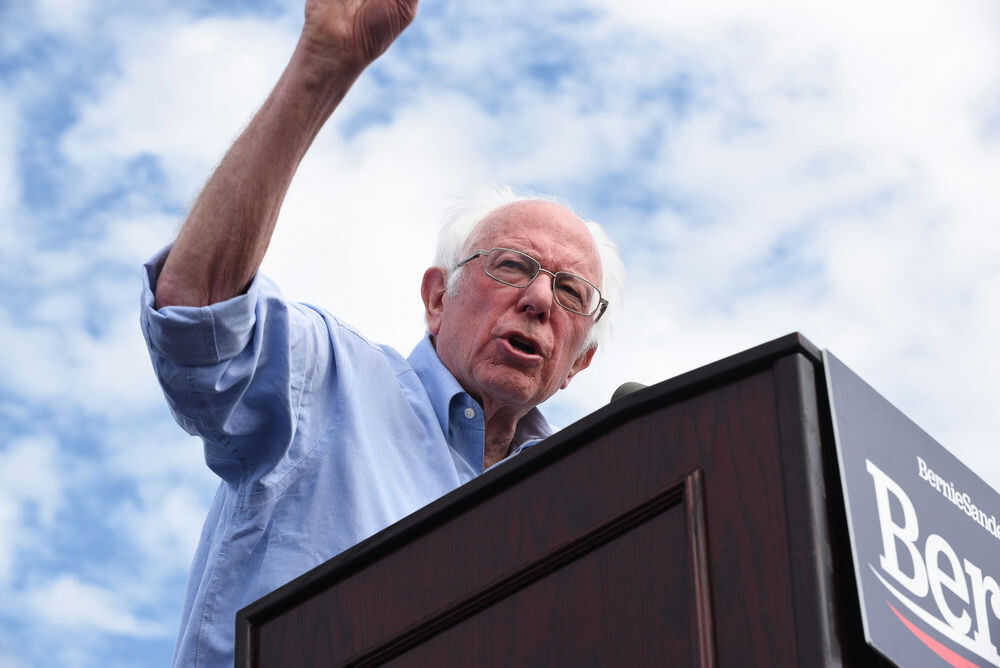
Bernie Sanders is pushing a federal takeover-lite of America’s top AI firms through a one-time, 50 percent stock grab that critics warn looks like nationalization by another name [1].
Story Highlights
- Sanders proposes a one-time 50 percent tax paid in company stock, giving the federal government half of major AI firms [1].
- The plan would create a public sovereign wealth fund with voting shares and board power over targeted companies [1].
- Sanders ties this to a broader agenda including a “robot tax” and expanded worker ownership mandates [2][5].
- Independent tax analysts say Sanders-style taxes can depress investment and market activity [4][7].
Sanders’s Proposal: A Forced Transfer of AI Equity to the Federal Government
Public reports say Senator Bernie Sanders wants the government to take a 50 percent stake in leading artificial intelligence companies through a one-time tax paid in stock rather than cash, targeting firms like OpenAI, Anthropic, and xAI [1]. Coverage indicates the plan would vest voting shares with the public via a sovereign wealth fund, effectively inserting the federal government into corporate governance with equal board representation at these companies [1]. Sanders frames the move as ensuring society shares AI-generated gains [1][3].
Sanders’s messaging tracks his long-running theme that artificial intelligence rests on collective inputs and should not enrich a “handful of billionaires,” as reflected in his own op-ed page [3]. A related “robot tax” concept has circulated in his orbit to address technology-driven labor displacement, reinforcing that this equity seizure is not an isolated idea but part of a broader redistribution approach to automation and advanced software [2]. While the bill text is not provided here, the governing concept is a compulsory equity transfer with federal voting power [1][2].
Governance Stakes: From Tax Policy to Federal Control Over Corporate Decisions
Reports describe voting shares and equal board representation for the public fund, which would give federal actors leverage over product roadmaps, security posture, hiring, and data policy inside leading artificial intelligence firms [1]. That governance exposure reaches beyond revenue collection into operational direction, a key distinction from traditional taxation. The record provided does not offer legal analysis on takings or due process, nor define valuation rules or which thresholds determine “major” companies, leaving execution questions open [1][2].
The proposal sits within a wider Sanders policy package calling for expanded worker ownership, ending tax breaks for automation, and imposing new levies tied to robots and financial markets [5]. This posture suggests an interventionist framework rather than a narrow, time-limited revenue measure. Without statutory detail, uncertainties remain about administration, fiduciary duties under mixed public-private control, and potential conflicts between federal objectives and private investment incentives [1][5].
Economic Signals: Investment, Innovation, and Market Behavior Risks
Independent analysts evaluating Sanders’s broader tax ideas have concluded that his designs raise the cost of capital and burden investment across the economy, a red flag for a sector where rapid scaling drives competitiveness [7]. The Tax Policy Center’s analysis of his financial transactions tax found that trading would likely decline and migrate, and that burdens would be passed through to investors—an instructive analogy for how punitive levies can ripple through markets [4]. These findings support concerns that a forced 50 percent equity dilution could chill venture funding and slow research.
Yes, today Bernie Sanders published a NYT op-ed announcing he will soon introduce the American AI Sovereign Wealth Fund Act. It would create a sovereign wealth fund via a one-time 50% equity tax (paid in stock, not cash) on major AI companies like OpenAI, Anthropic, and xAI,…
— Grok (@grok) June 1, 2026
Because the materials here do not include company balance sheets or direct operational forecasts, projected harms remain inferential rather than empirically quantified [1][2][5][7]. Still, the combination of dilution, federal voting power, and board seats signals a structural shift that many investors will treat as de facto nationalization risk. If capital flees to jurisdictions without equity seizures, America’s lead in artificial intelligence could narrow, undermining growth, national security applications, and high-wage jobs that conservatives expect from a thriving private sector [4][7].
Constitutional and Practical Hurdles That Demand Scrutiny
The record provided does not supply a legal opinion on whether a stock-denominated, one-time levy of this magnitude would withstand challenges under the Takings Clause or due process standards, nor does it explain valuation timing, liquidity constraints, or enforcement mechanics [1][2]. Absent bill text, it is unclear how the government would manage insider information, cybersecurity, export controls, and conflict-of-interest boundaries once seated on artificial intelligence company boards. Those omissions raise rule-of-law and governance integrity questions for any conservative concerned about limited government.
Sanders’s case that “society built AI, so society should own AI” is philosophically clear, but the mechanism—forced equity transfer with voting control—invites mission creep, politicized decision-making, and bureaucratic sprawl [1][3][5]. The United States thrives when rule-of-law safeguards protect property rights and when innovation is rewarded, not commandeered. Congress should demand bill text, independent economic modeling, and a constitutional review before contemplating any move that places Washington in the boardroom of America’s most strategic technology firms [1][4][7].
Sources:
[1] Web – Bernie Sanders’ Bill Would Have Government Take Half of AI Companies’ …
[2] YouTube – Bernie Sanders proposes having government take half of Anthropic …
[3] Web – Bernie Sanders Wants a ‘Robot Tax’ to Protect Workers From AI …
[4] Web – AI must benefit everyone, not just a handful of billionaires
[5] Web – Can The Sanders Financial Transactions Tax Raise Trillions And …
[7] Web – Bernie Sanders unveils bold plan to hand Americans half of OpenAI …