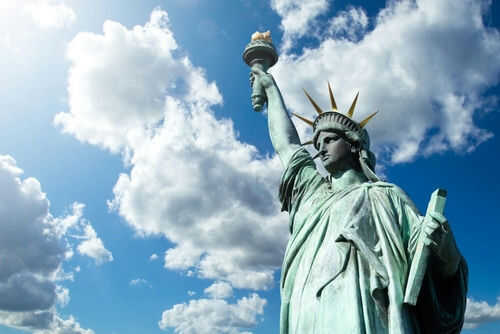
A Justice Department lawyer just told federal judges that under their legal theory no one could stop a president from bulldozing the Statue of Liberty, raising serious questions about how far unelected lawyers think government power can go.[1][2][3]
Story Snapshot
- A Department of Justice lawyer argued in court that no one would have standing to stop a president from demolishing the Statue of Liberty.[1][2][3]
- The claim came as the Biden‑era career side of the Department defended Trump’s White House ballroom project by pushing an extreme view of executive power over federal property.[1][2][3]
- Appeals court judges pressed the lawyer on whether any statute allowed demolition of landmarks, highlighting the stakes for constitutional checks and balances.[1]
- The incident underscores how deeply embedded establishment lawyers still favor centralized power over accountability, even under a constitutionalist administration.[1][3]
DOJ’s Statue of Liberty Argument: What Was Said in Court
During oral arguments before the United States Court of Appeals in Washington, a Department of Justice attorney defending the legality of President Trump’s White House ballroom construction was pressed on how far the administration’s theory of presidential power would reach.[1][2][3] When a judge asked whether, under that theory, the government could quickly bulldoze the Statue of Liberty so that “nothing can be done,” the lawyer answered, “I think that’s right, yes,” meaning no one would have standing to sue in time.[1][2][3] The lawyer’s position turned on a standing argument: that ordinary Americans, even those with deep family and cultural ties to the monument, would not be legally recognized as injured in a way courts could remedy before the damage was done.[1][2] That answer, on the record in open court, did not come from a columnist or activist but from the federal government’s own litigation counsel, speaking for the United States.[1][2][3]
Media reports identify the lawyer as Yaakov Roth, a principal deputy assistant attorney general, who was arguing that the nonprofit National Trust for Historic Preservation could not block the administration’s East Wing demolition and ballroom project.[1][3] According to contemporaneous coverage, Roth agreed that if the government “moved too fast” to bulldoze the Statue of Liberty, “nothing can be done,” and confirmed that the same logic he was using for the White House would apply to that national monument.[1] That exchange was not a stray joke; it was used to illustrate his core claim that presidential control over federal property, executed quickly, could outrun any attempt by citizens or civic groups to seek judicial relief.[1][2][3] For many conservatives, hearing a federal lawyer calmly concede that no court could help if the government destroyed an iconic symbol of freedom crystallizes long‑running concerns about bureaucrats who see themselves as above the people, the states, and even Congress.
Ballroom Fight Reveals a Bigger Battle Over Executive Power
The courtroom fireworks grew out of a narrower fight over Trump’s plan to demolish part of the White House East Wing and build a large ballroom, a project critics said was increasingly expensive and lacked explicit congressional approval.[1][2][3] A federal district judge, Richard Leon, had already ruled that Trump exceeded his authority, issuing an order to halt the construction until legal questions were resolved.[1] The Department of Justice went to the appeals court seeking to overturn that injunction, arguing that the preservation group behind the lawsuit had no right to be in court and that, in any event, judges could not truly stop the project once demolition advanced.[1][2] Appeals judges did not simply nod along; Judge Bradley Garcia reportedly told the government that the statute the Department was relying on “cannot be a source of authority for demolishing and replacing” parts of the White House structure, a direct challenge to the breadth of the administration’s claimed power.[1] That back‑and‑forth shows that, even with a strong executive‑power theory on the table, federal courts still see themselves as a check when statutes and the Constitution do not clearly hand the president a blank check.
At the same time, the Justice Department’s litigation strategy fits a broader pattern that long predates this single case: across administrations, government lawyers often push aggressive readings of presidential control over monuments, land, and federal property until judges or Congress push back.[1][3] Separate reporting describes how the Department’s Office of Legal Counsel previously issued an opinion claiming presidents can shrink or even revoke national monuments that were created under the Antiquities Act, reversing a long‑standing view that such protective designations were effectively permanent.[3] That is the same institutional culture that produced this Statue of Liberty hypothetical: a default instinct to expand centralized authority, test the limits of judicial review, and invoke standing rules so that citizens and watchdog groups are left on the sidelines.[1][3] For constitutional conservatives, the danger is not just one president; it is a permanent legal bureaucracy that, regardless of who sits in the Oval Office, resists outside scrutiny while treating foundational symbols as disposable assets on a federal balance sheet.
Why This Matters for Conservatives, Congress, and the Constitution
The most alarming part of the Department of Justice’s position is not that anyone in the Trump administration wants to touch the Statue of Liberty—nothing in the record suggests that.[1][2][3] The real alarm is that a government lawyer, in 2026 America, felt comfortable telling a panel of judges that if such a demolition were ordered and carried out quickly, the people would be powerless to stop it in court.[1][2] That attitude cuts directly against the conservative understanding that our system is based on limited government, separation of powers, and the idea that public officials are stewards, not owners, of national treasures. It also confirms why many on the right continue to distrust a Washington establishment that has, for decades, brushed aside concerns about executive overreach, whether on emergency powers, land use, or pandemic mandates.
In the specific context of today's (June 5, 2026) D.C. Circuit Court of Appeals hearing on the National Trust for Historic Preservation's lawsuit against the Trump White House ballroom project, the DOJ lawyer's statements were a narrow legal argument about standing and… https://t.co/4E4A0RaGYS
— Y Not (@Schelmy) June 6, 2026
For Trump‑supporting readers, the lesson is two‑fold. First, this episode underscores the need for continued vigilance and oversight of the permanent legal bureaucracy inside the Department of Justice, which does not automatically change just because voters elect a president who promises to drain the swamp.[1][3] Second, it highlights why Congress, especially the House, must jealously guard its power of the purse and its role in supervising major federal projects and national monuments, rather than surrendering decisions to unelected litigators.[1][3] When judges are left to confront sweeping theories that treat even the Statue of Liberty as fair game, it should be a wake‑up call for every American who cares about preserving our history, defending local and state voices, and passing on to our children a country where no official—Republican or Democrat—can claim the power to erase our national heritage by moving “too fast” for the people to react.
Sources:
[1] Web – DOJ: No role for courts if Trump demolishes Statue of Liberty…
[2] Web – DOJ argues Trump could ‘bulldoze’ Statue of Liberty during White …
[3] YouTube – How The Supreme Court’s Decision Could Affect The DOJ’s …